
Future present
On resilience, governance, justice, equity...and other antidotes to food dystopia


The last few weeks in the UK have felt like a scene from Bladerunner with its relentless rain and perpetual gloaming (…cue gratuitous clip of the epic ending).
But while I’m (still) determined to prioritise posts on agency and action this year, I cannot follow the UK government and ignore one of the most seismic reports to emerge in recent years. A report from one of its own departments.
The national security assessment on Global biodiversity loss, ecosystem collapse and national security should have been out last year. But, according to this disturbing Guardian opinion piece by George Monbiot, it was deliberately kept in the dark. As were we.
Deemed too scary and too revealing of a governmental failure to act, it took a freedom of information request by the Green Alliance for it to see the light of day. Even then, the media chose to ignore it in favour of more pandering to the attention-junkie in the White House.
The report makes seven ‘key judgements’ with linked confidence ratings as follows:
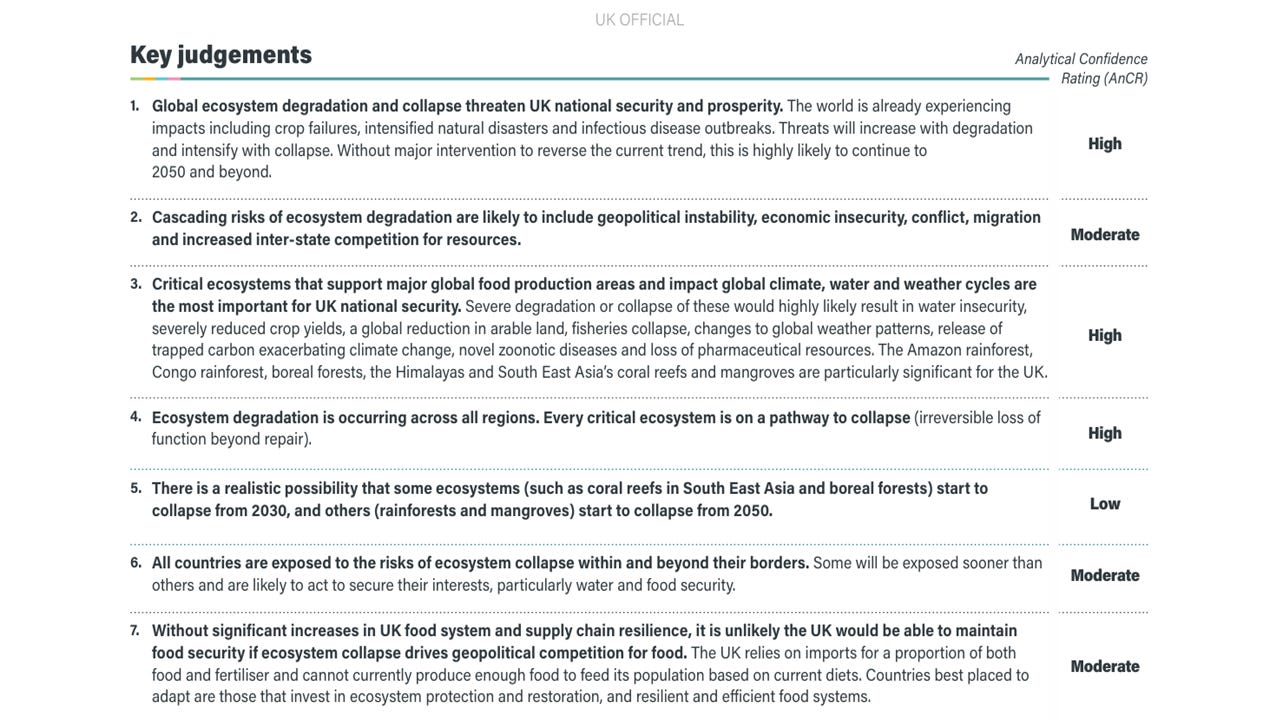
Smack in the middle of this list is the high-confidence judgement that:
‘ecosystem degradation is occurring across all regions. Every critical ecosystem is on a pathway to collapse (irreversible loss of function beyond repair).’
In her excellent debut Substack post, Sammi Landsman unpacks the key word:
‘it is striking how cleanly ‘function’ separates nature from people, as if we are not made of the same materials. As if degraded ecosystems are not already showing up as degraded lives.’
Another recent expert consultation has highlighted the ways in which multiple chronic challenges – climate crisis, poor policy implementation, rising inequality, food supply chain consolidation and risks from just-in-time food supply – have created a tinderbox of acute risk of food crisis in the UK.
Three triggers – a cyber-attack, an extreme weather event or a new international conflict— could lead to a ‘food availability and/or price shock that could result in widespread fear of unsafe or inadequate food, leading to violence.’
To build resilience, the report calls for deep system-wide changes. First we need to bullet-proof policy from shifts in governments. Food system transformation isn’t going to happen overnight.
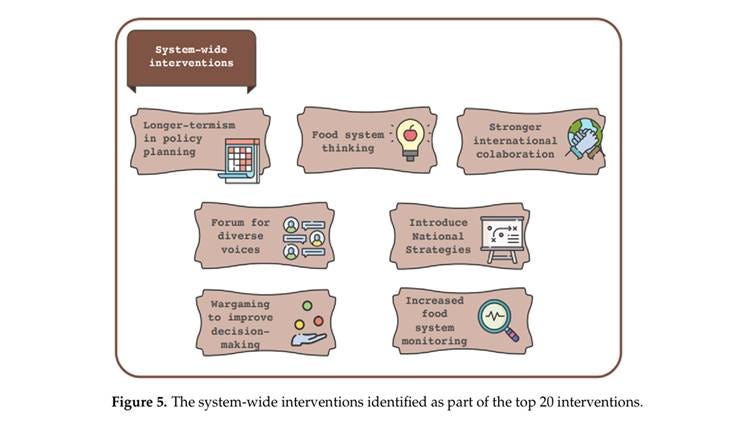
Second, beyond rhetorical promises, we need serious cross-government coordination and harmonized action on a shared food systems agenda. And third, strengthened international collaboration and forums to bring in diverse voices including those most affected by food insecurity (‘not about us, without us’).
On food governance
A recent narrative review and literature synthesis by Scott Slater and colleagues asks ‘How has the global food governance system evolved, and what challenges does it currently pose for food systems transformation?’
The brief history of global food governance is worth checking out:
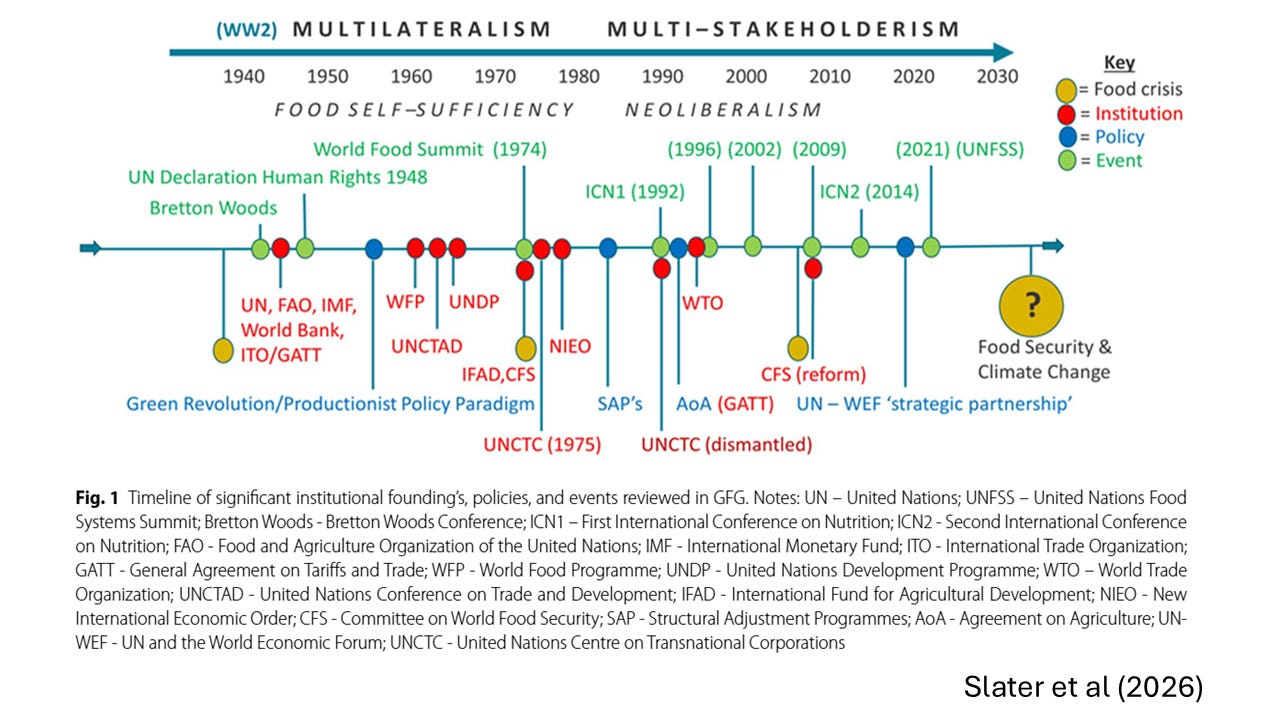
(We had a similar nutrition history timeline in our IFPRI 50th anniversary chapter)
The authors move on to outline the big challenges we now face before offering a set of priority recommendations for multilateral organisations and national governments.
The latter broadly align with earlier proposals by IPES-Food, HLPE and others. These include eliminating conflicts of interest, reducing power asymmetries, repurposing food system subsidies and financial flows and moving towards more robust legal mechanisms that hold all actors (especially the powerful) accountable for social and environmental harm.
Food economies need to shed decades of corporate capture and become grounded in principles of agroecology, justice, human rights, and food sovereignty in which the voices of those most affected are heard and acted upon.
On food justice and equity
Two more recent publications examining the links between food system transformation, equity and justice caught my eye.
The first: Sustainability without Justice? unpacks equity and how it underpins and shapes what food systems look like and what they can become. Three aspects are key:
Distributive equity – fair access to resources and opportunities
Procedural equity – marginalised people participate in decisions that affect them
Recognitional equity – acknowledgement of the way historical discrimination has driven unequal access to resources and opportunities.
Second, a paper by Marta Lopez Cifuentes and colleagues which applies a ‘just sustainability transitions’ lens to food governance. We need to view ‘justice’ not just as a goal, but as dynamic, relational and process-oriented.
Which reminds me of Martin Luther King Jr’s ‘The end is pre-existent in the means’
Devoured by Big Food
Back in the UK, another recent blog by farmer and writer James Rebanks asks who do we want to feed us, now that Big Food has ‘devoured British farmers’?
The first country in the world to industrialise, Britain seems to be hanging on to this heritage as one of the world’s biggest consumers of industrial UPFs. Most food now comes from factories, not farms.
It’s actually top of the European charts, with over half its diet deriving from UPFs compared to just 10% in Portugal, 13% Italy and 14% France.
‘These nations defended their traditional food cultures, as a matter of pride. They never stopped believing that eating well remained an essential part of a good life. They also used planning laws and local government to make life more difficult for Big Food corporations, and encouraged their politicians to say no.’
Hooked on power
‘From Tobacco to Ultra processed Food’ – a new paper by Ashley Gearhardt, Kelly Brownell and Alan Brandt unpacks the way industrial engineering fuels epidemics of preventable disease.
Kelly Brownell (and Kenneth Warner) had first caught my attention with this fascinating 2009 paper on ‘the perils of ignoring history’ that led to more digging. The extraordinary story of the tobacco industry became the lead in to the ‘dark arts’ chapter of my book.
This new paper reveals how dose optimization and hedonic manipulation are key engineering strategies that Big Food has adopted from Big Tobacco. UPFs should therefore be evaluated not only through a nutritional lens but also as addictive, industrially engineered substances.
‘Unlike tobacco, however, the solution is already in our hands: minimally and traditionally processed foods that have sustained human health for millennia. Legal action against health damages and misleading health claims, re strictions on UPF advertising, taxation of nutrient-poor UPFs, markedly reducing UPFs in schools and hospitals, and clearer labeling of ultraprocessing could all serve as next steps.’
In another opinion piece from the Iowa Gazette, Sofia DeMartino includes a disturbing anecdote on industrial power. At a recent Iowa Governor’s Conference on Public Health a public health official from a small town stated from the podium that she had to be “careful” when talking about all of the illness, injury, and death related to the local processing plant because they were also the area’s biggest employer and economic engine.
‘Public Health didn’t feel comfortable protecting the PUBLIC from the CORPORATION. That’s not corruption, it’s structural dependence. And it’s exactly how a food system becomes an economic system, becomes a political system, becomes a public-health crisis.’
Which brings us to Mike Tyson’s $10 million, 30 second ad at the Super Bowl.
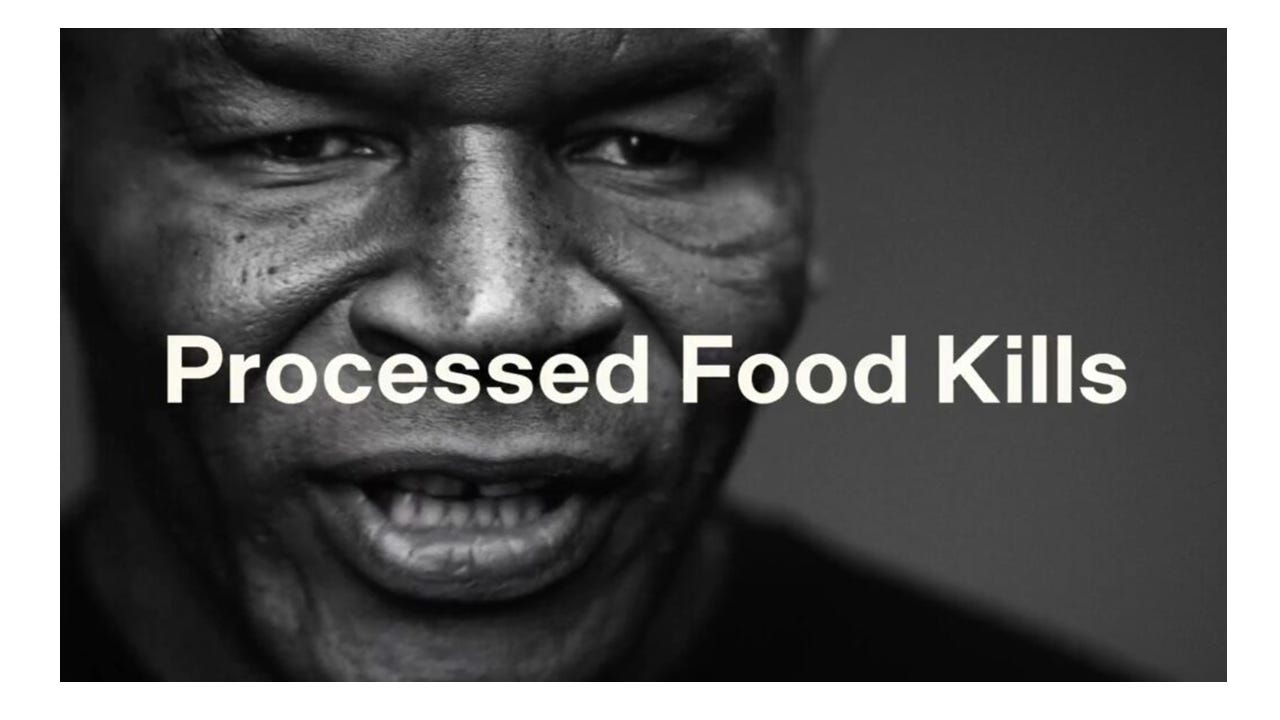
Shame they didn’t pay a bit more to add ‘ultra’ or ‘highly’ to the beginning…
On commercial determinants of health
Check out these newsletters…
First, Commercially Determined, launched by Yulia Chuvileva. This lively post lists out key ploys and tactics corporations use to stop governments getting in their way.
I do enjoy these:
It’s not a problem. It’s totally normal… actually a good thing.
The problem is so complex. Many factors contribute to it
Fine, maybe sometimes harm happens, but we had no idea…
Anyway, it harms only a few “problem” consumers. Don’t punish the rest of us.
Consumers are ill informed. You should just educate people.
Trust us, we are the good guys…we’re experts.
Don’t trust their scientists…they’re emotional, biased, incompetent
No need to regulate, we’ll change on our own
Policies won’t work…they’ll hurt the economy, kill innovation, destroy jobs.
Regulation is government overreach…a nanny state trampling freedom
We see these same tactics and tropes employed by the fossil fuel industry lobby, tobacco (as above), gambling, UPFs, plastics, chemical pollutants.
Another punchy newsletter, edited by Diarmid O’Sullivan, is Critical Takes on Corporate Power – for ‘people from civil society around the world who see the power of multinational corporations as a serious problem for justice, democracy and nature.’
Moving on to the super-important, much-neglected issue of accountability (for commercial determinants), the UNU International Institute of Global Health have just posted these two webinars:
Corporate Accountability and Sustainable Food System Transitions
Rethinking Corporate Accountability in Global Health: Beyond Rankings & Voluntary Measures
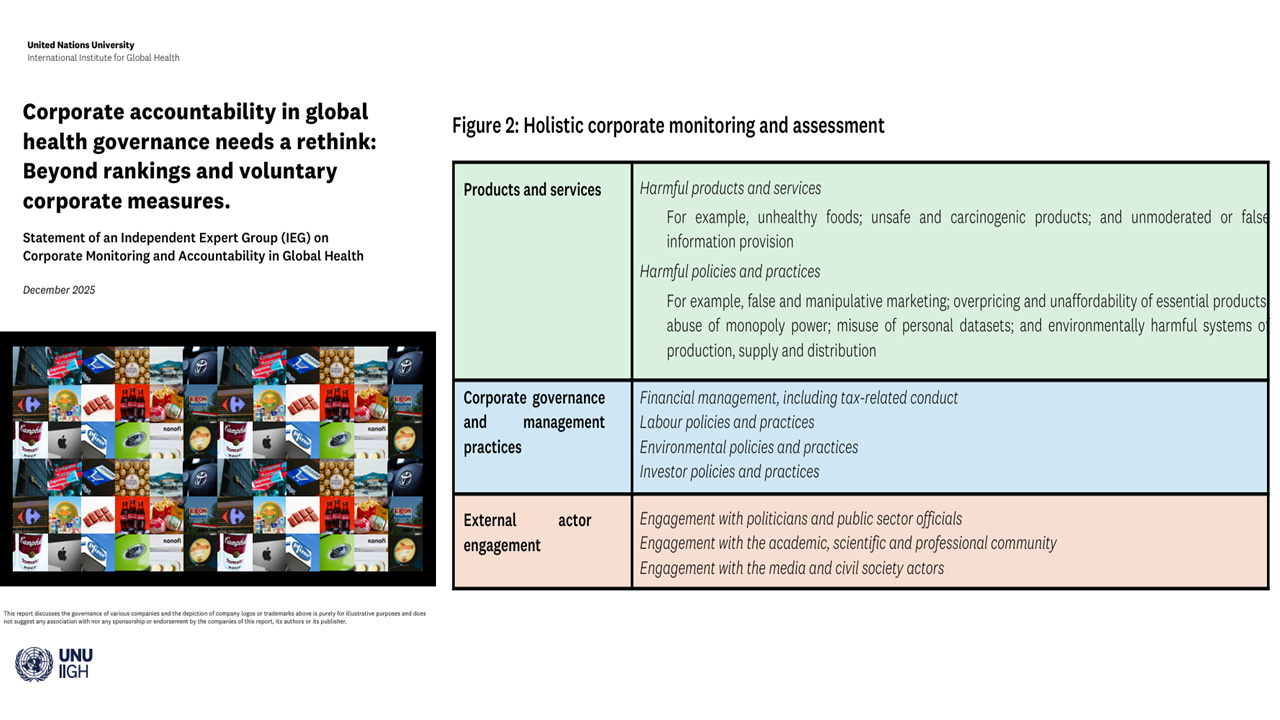
And finally, WHO has released this call for papers on commercial determinants of health – accentuating positive, curtailing negative impacts…take a look.
Fast food, fast forward
A quarter century after his seminal first edition, Eric Schlosser has a re-issue of Fast Food Nation on the shelves.
After considering a full re-write, he figured that many of the same problems described then were still very relevant now. Multiplied by 10. Which is why he chose to bring out it out ‘as is’ with an afterword/update. This long read tells the story.
Check out the advert that appeared just before it, in the hard copy:
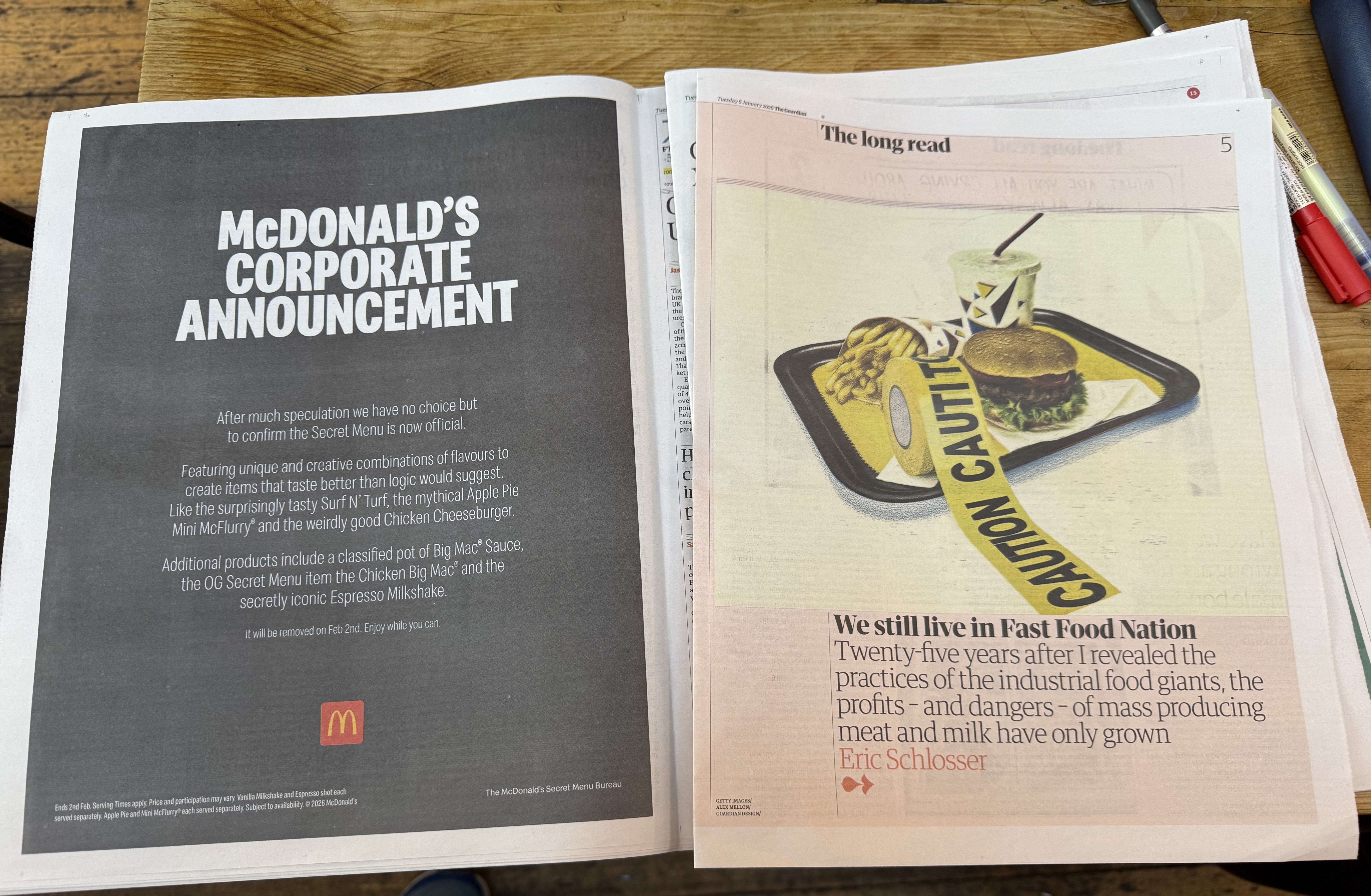
This is telling:
‘The history of the 20th century was dominated by the struggle against totalitarian systems of state power,” I wrote in Fast Food Nation. “The 21st will no doubt be marked by a struggle to curtail excessive corporate power.” Well, at least I got it half-right. We now have to struggle against both.’
I’m off to Berlin for a food documentary before cycling and hopefully some sun in Portugal. See you in March!
Thanks for this, Stuart. Lots of great stuff in here and it will take me a little while to process it all.