
It's (not) on you
The great lifestyle deceit and why we need to re-politicise public health


You do it to yourself, you do
You and no-one else
[Thom Yorke, 1995]
It’s a great song, but when it comes to most people on our planet, it just isn’t true.
Which made this recent Guardian headline jump off the screen the other day:
‘At least 80% responsibility for ill health in old age down to individual, study says’
Where to start with this?
Well, first of all, it’s not a ‘study,’ it’s a short report, written by ‘four long-time friends’ who came together in Oxford in 2021.
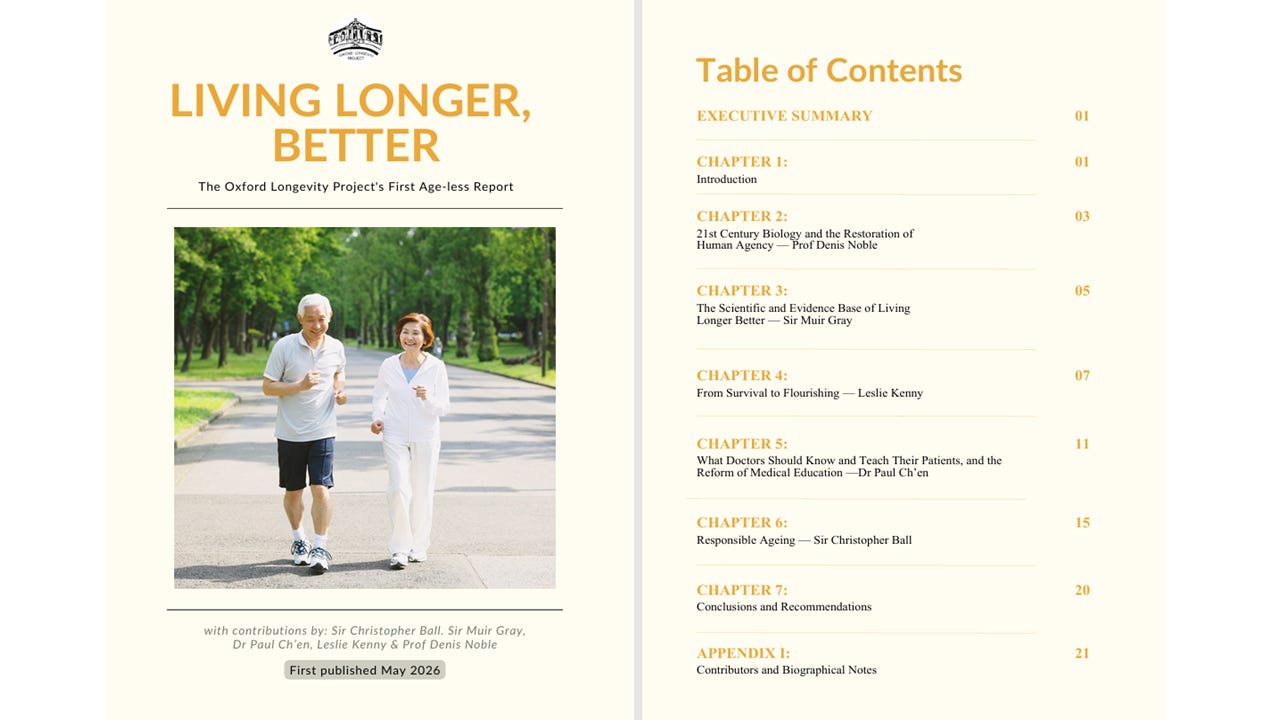
The first report of the Oxford Longevity Project…which implies more will follow.
It’s funded from the profits made by Oxford Healthspan, a company that sells spermidine – a supplement ‘sourced from Japan, guided by Oxford science that’s designed to support cellular renewal and healthy aging from within.’
The report is essentially a series of anecdotal opinion pieces (‘chapters’) by each of the four friends. It has just 10 citations, none of which are to scientific studies, most of which are self-citations.
The 80% number appears to have been pulled out of thin air.
The authors don’t declare any conflicts of interest, despite one of their top recommendations being a judicious use of supplements.
But worst of all, the report completely ignores the work of hundreds of scientists who for many years have been investigating and documenting the major upstream social, commercial, economic, political and environmental determinants of health.
Discussions of the way poverty, inequity, racism, childhood trauma intersect and interact with health are not mentioned.
To state the obvious, there are reams of scientific papers that show that most chronic diseases, including heart disease, cancers, dementia, diabetes are heavily impacted by factors that, in the main, are beyond individual control. Structural, not behavioural, factors.
This all varies with regard to who we are, where we are and what we’ve lived through (our ‘exposome’) and it will vary by disease – but cumulatively, for most people, these risks are far, far larger than any we can control by what we choose to do.
The lifestyle deception
‘Lifestyle’ is a word that was confected and propagated by industries to obscure and deceive – to distract us from the harms they were generating. To keep the spotlight on the consumer, not the product or the practices behind it.
‘eat a balanced diet as part of a healthy lifestyle’
‘Lifestyle’ frames public health at a personal level – effectively blaming individuals for making irrational decisions that are harmful to their health.
The logic of this framing is that we are to blame when things go wrong, when we get sick. The false narrative of ‘individual empowerment’ is not just a smokescreen, it’s a get-out-of-jail card for both industry and government.
Big Food can conveniently obviate responsibility for harms, just as it passes the cost of these harms down the line to individuals, households and health systems.
The lifestyle deception aligns with the ‘nanny state’ argument made by libertarians and passive governments. Libertarian think tanks (sic) even have ‘lifestyle economists’ while ‘lifestyle medicine’ gurus flood social media with ‘nutritional advice’.
It’s so seductive (including to Guardian editors!) because it sounds so empowering, at a time when trust in our public institutions is so low.
But it’s a deception, a smokescreen that stigmatizes, alienates and insults people.
If something is addictive, how can it be described as a choice?
If you’re too poor to access or afford a healthy diet, how is that a choice?
Are young children expected to exercise personal responsibility?
If these are not choices, then you’re not personally responsible.
And it’s counter-productive — the failure of the nudge theory of behavioural change, as recently admitted by its proponents, is just one example.
The wild west of wellness
The ideology of lifestyle and personal responsibility is foundational to the multi-trillion-dollar wellness industry that now encompasses myriad products and practices affecting health and well-being. (I wrote about its dangers earlier)
Just out is this excellent perspective piece by Nancy Karreman and colleagues that applies a commercial determinants of health lens to ‘wellness’, examining its intersections with systems of capital production, corporate interests, and neoliberal norms of personal responsibility.
The wellness industry (‘Big Well,’ if you will) comprises the commercialisation, business activity, and financialisation of wellness.
And boy, is it financialised!
One estimate puts its value at $6.8 trillion in 2024, with projected growth to $9 trillion by 2028.
An industry that revolves around supplements, into which Big Food is now moving fast. (Nestlé for example is buying up supplement and lifestyle companies, including the Living Matrix functional medicine platform and the ‘lifestyle brand’ Vital Proteins)
Wellness is still the wild west. An industry that’s barely regulated as its products are not considered to be medical products and they have no novel ingredients. Rarely tested, they’re assumed to pose little risk to consumers.
Safety and effectiveness are of course two different things. If a product is safe but not effective, then you’re wasting money. If it’s neither safe nor effective you’re wasting your money and your health.
Just as ultra-processed products displace healthy foods, wellness products displace other conventional, evidence-based therapies and products (e.g. chemotherapy regimens to treat cancers.)
And money continues to be made.
Economic structures underpinning the wellness industry overlap and intersect with those enabling Big Pharma and Big Food. (‘now we’ll sell you the cure’)
It’s fuelled by the digital revolution which amplifies misinformation. Social media disseminates and amplifies health messaging while being itself a commercial determinant of health. Especially mental health. (most anti-vax disinformation comes from 12 wellness influencers according to a report by the Center for Countering Digital Hate in 2021)
Karreman also examines the ‘wellness to alt right’ pipeline whereby wellness is increasingly associated with right-wing political positions and values.
MAHA in the US is a case in point as it has finally come to be seen for what it is. A movement that has not tackled the systemic problems with food and health systems, as it promised. Instead MAHA recommends new research and data (while research and data organisations are being decimated), lifestyle change programs and industry self-regulation, none of which will make much of a difference.
This take on MAHA was one of the earliest and one of the best, starring RFK Jr. as one in a long historical line of wellness influencers:
“Like religion, wellness doesn’t captivate by empirically proving its truth to adherents. But it does meet certain psychological needs. By contrast, the crucial project of the U.S. public-health apparatus is not to soothe its citizens’ existential woes, but to make policies that address the health of the masses. An administration that prioritizes the sacraments of wellness above all—especially if it undermines the efficacy of vaccines, cuts funding for infectious-disease research, and reduces regulation around raw milk—won’t make Americans healthier.”
And there’s this vid on the ‘MAHA funnel’ linking up conspiracy fantasies, healthcare demonisation (including anti-vax) and the brazen promotion of supplements and hacks by influencers who are invested in them.
MAHA was always going to be trumped by MAGA.
*
The personal empowerment/individual responsibility/freedom of choice narrative is still deeply entrenched in the UK, as recent work has shown.
This scoping review by Nestor Serrano-Fuentes and colleagues shows that across the domains of the public, mass media and government, poor diet and obesity are almost consistently framed as being an individual responsibility.
Interestingly, in this review, left-wing media appeared to be more likely to focus on underlying structural drivers of ill-health (though apparently not with regard to the Guardian and the Oxford Longevity Project, it seems!)
The UK review didn’t cover academia as a domain. But here we see academia (Oxford University, no less) amplifying industry narratives which are then further amplified by the mainstream media.
To do
For an evidence-informed read on what drives ill-health, check out various Lancet series from recent years, including the commercial determinants of health (2023) and the ultra-processed food (2025) series. And have a read of Devi Sridhar’s excellent book .
None of the above implies that we don’t have any responsibility…that everything is pre-determined or driven by forces beyond ourselves. Of course not. We have agency – both individual and collective – but the sad reality is some have a lot less than others.
What we really need is a radical shift in public, media and policy framing to drive strong regulatory action by governments.
Media need to find better ways to counter the pollution of discourse on food and health and to tell the stories that really matter. One part of this, would be to inoculate the public by exposing the commercial origins of language used to distract from real causes. Words like ‘litterbug’, (carbon) ‘footprint’, ‘nanny state’, ‘lifestyle’, ‘climate change’ (not crisis), ‘global warming’ (not heating) – that all originate from industries keen to pass the buck on to us.
With a more truthful, evidence-informed framing of the drivers of ill-health, we can better demand our governments protect all citizens from public health harms.
Wow, that report is wild. And of course the use of a statistic makes it seem more scientifically legitimate to the untrained eye. This also stood out to me, “Big Food can conveniently obviate responsibility for harms, just as it passes the cost of these harms down the line to individuals, households and health systems.” Yep. They create the problem which is then “solved” by big pharma and big wellness. But the pieces seem disjointed enough to the average person that we don’t realize how we are locked into this insidious cycle.