
Plastic or Planet?
The Busan treaty talks


“We are not just negotiating a treaty. We're deciding whether we care enough to save ourselves.
Plastics for Panama are a weapon of mass destruction. Plastics are not convenience.
Plastics are poison. Every piece that we allow to produce without limits is a direct assault on our health, on our nature, and our children.
If we don't get an ambitious treaty out of Busan, it will be a global betrayal. If we don't get an ambitious treaty out of Busan, history will not forgive us.
This is the time to step up or get out”
[Juan Carlos Monterrey, Special Representative for Climate Change, Panama]
Before we review what happened in Busan, here are some numbers:
400 million tonnes of plastic waste produced every year…
…rising to 736 million by 2040 unless we act.
2,000 garbage trucks of plastic dumped in world's oceans, rivers, lakes every day.
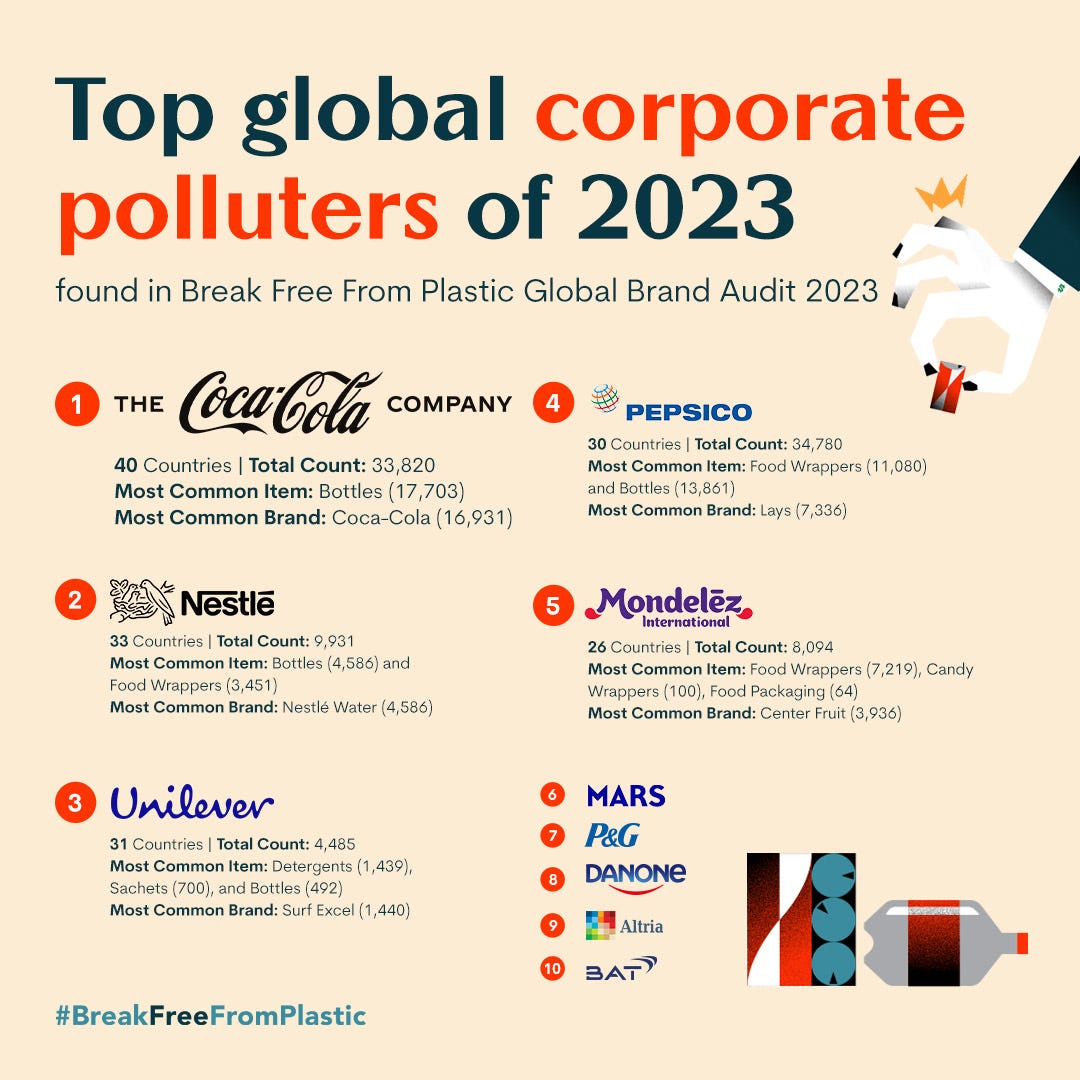
Ultra-processed food (UPF) companies are, by far, the biggest polluters:
A few more numbers…of delegates in attendance:
Host (Republic of Korea): 140
Latin American and Caribbean region: 165
EU + all Member States combined: 191
Fossil fuel and chemical industry lobbyists: 220
Industry lobbyists outnumbered the Scientists’ Coalition for An Effective Plastic Treaty by three to one, and the Indigenous Peoples’ Caucus by almost nine to one.
Is it any surprise then that the Intergovernmental Negotiating Committee (INC-5) failed to deliver a plastics treaty in Busan earlier today?
Negotiations were deferred to yet another session as a small bloc of petrostates countries (including Saudi Arabia, Iran and Russia) blocked the inclusion of binding provisions on cutting production.
Detox
In a recent paper — led by Joe Yates who was in Busan — we ask, how do we call time on the toxic relationship between plastics and UPFs? We offer four propositions:
We need more imagination and political will to realise the co-benefits of tackling the common drivers of climate change, UPF diet-related illness, plastics and chemical pollution.
We need interdisciplinary research collaboration and cross-cutting data to equip policymakers to centre health and the environment in national policies, international negotiations, and trade decision-making.
We need clear safety, sustainability, transparency and essentiality criteria for plastics using a precautionary, hazard-based approach that takes account of chronic exposure
And we need to tackle the commercial determinants — the intersecting interests and strategies of Big Food, Petrochemical and Plastic industries — through strong, joined-up government-led regulation.
Not only are Big Food corporations the main plastic polluters, they employ the full range of tactics to block any political change that would threaten their bottom line.
In Chapter 13 of ‘Food Fight’ — The Dark Arts — I try to unpack the full bag of tricks. The more you look, the more you find…this chapter started to take on a life of its own, ballooning in size until my wonderful editor stepped in to help me rein it in.
One of the dark arts involves the use ‘corporate social responsibility’ initiatives to derail and delay. There are so many examples of boutique CSR projects. Designed to be high-profile and media-friendly, they are small-scale and inconsequential when viewed against the large-scale harms generated by the corporation’s core business.
An example — the formation by five fossil fuel and chemical companies of a voluntary alliance to end plastic waste. The reality? Together, these companies have produced 1,000 times more new plastic than the waste they have cleared in five years.
‘Killer tactics’ like these have been highlighted in an excellent report and webinar by the Alcohol Health Alliance (AHA), Obesity Health Alliance (OHA) and Action on Smoking and Health (ASH).
Within the burgeoning discourse on ultra-processed food and drinks, the main focus has tended to be on human health…much less on planetary health and the marriage made in hell with plastics pollution.
The fact is we pay for ultra-processed foods many times over — first, via the subsidies that governments (using our taxes) pay big corporations to over-produce a handful of staple crops, then via the cost of the food/product at the supermarket checkout, then via human and planetary ill-health that result from its over-consumption.
And so long as commercial determinants go unchecked, the ‘global betrayal’ highlighted by Juan Carlos Monterrey will continue.
Bits and bobs…
More here on Busan from IBFAN.
Another plastic horror story — this time involving the corporate capture of water in Catalonia by Nestlé, Danone and other food and drink companies. In the Montseny region, a volunteer group recently counted 185 trucks from 4 bottling plants carrying 5.6 million litres per day, while local farmers, struggling with drought, had to drive to supermarkets to buy it back in 5-litre plastic bottles.
Imperial College, London held a symposium last week — ‘Ultra-Processed Foods: The Scope for Government Action’ — that was packed with evidence, insight and ideas on tackling UPF harms. Full webcast here.
Until next week…
Thanks for reading FOOD FIGHT FILES! Subscribe for free to receive new posts.