
Time for a break?

Last week, I spent a couple of days as a Groundswell rookie. It was a lot of fun.
Groundswell is the UK’s leading regenerative farming gathering – held at Lannock Farm in Hertfordshire – that I somehow failed to get to in its first nine years of life.

Full disclosure: I come from a different world. Or at least a different part of the food system — the public-facing side that connects food products with health outcomes.
My world collided with this one on what became one of its biggest talking points – Wildfarmed’s deal to supply Nestlé with regeneratively-farmed wheat for its KitKats. We’ll get to that shortly...
First, a few reflections.
What is regenerative?
Well, there’s no agreed universal definition but the focus is on a combination of minimal soil-tilling, cover crops, crop diversity, agro-forestry, managed grazing and use of organic fertilizers and pest-control methods.
Working with nature, not plundering it.
Over time, we’ll see improvements in soil, water, biodiversity, climate resilience, and more vibrant, viable farming communities.
A loose definition enables flexibility and context-specificity and empowers the farmer.
But it may come with a price if it leaves the door open to another form of corporate capture. And the big questions then, are who pays this price, when and how?
Big Ag/Food has sought to seize the narrative by putting forward their own definitions and frameworks. Their preferred focus on outcomes, may be designed to divert attention away from harmful inputs (e.g. fertilisers and pesticides) while also facilitating incremental tweaking, rather than truly transforming agri-food systems.
Regen or degen?
Last month, a group of organisations working ‘for the true transformation of food systems in Europe’ released a joint statement:
‘We are alarmed by the widespread and misleading use of ‘regenerative agriculture’ in corporate branding and EU policy initiatives. What is called ‘regenerative’ can include highly degenerative practices masked by a few cosmetic measures.’
‘Europe must ensure that actions speak larger than words and that future transitions remain credible, transparent, grounded in the public interest, and anchored in verifiable and publicly governed approaches.’
This followed research by Corporate Europe Observatory (CEO) into the way corporations in the pesticide, dairy, and big food industries have used ‘regen ag’ as a smokescreen in lobbying the European Commission to promote a range of harmful practices, including the continued use of synthetic agrochemicals.
Which in turn followed the launch, three years ago, of the Sustainable Agriculture Initiative (SAI) Platform (including Big Food behemoths like Nestlé, Danone, PepsiCo, McDonalds, and Unilever along with Big Ag allies like Bayer, Cargill, ADM, Syngenta) that released its own definition of regenerative agriculture, along with a framework for benchmarking, assessments, and ‘normative claims’.
Rather than setting clear limits on pesticide or fertiliser use, its Regenerating Together Programme (RTP) emphasised improvements in efficiency or risk reduction.
Hmm…isn’t this a case of ‘marking your own homework’?
In recent research, the Food Foundation, Green Alliance and Table investigated corporate co-option of regen. They noted how easy it is for companies to opt for the lowest hanging fruits, and ignore core ‘bigger picture’ issues such as improving soils or environmental improvement across the whole of the food system.
A few views, including from the US:
‘A cover crop does not make a system regenerative. A carbon credit does not make a supply chain fair. A flower strip around a field does not erase pesticide dependency. A pilot project does not transform a business model. A beautiful word does not replace public rules.’
[Eduardo Cuoco, IFOAM]
‘The law must protect these good farmers and consumers, from farms that are just sustainable in name. The term regenerative agriculture cannot become a trick for greenwashing, used like a magic word without any connection to reality.’
[Luigi Tozzi, Safe Food Advocacy Europe]
‘Regenerative agriculture needs to be more than just buzzwords Big Ag uses to greenwash business as usual…While the Trump administration promises money for sustainable practices, it continues to cut conservation staff, support the pesticide industry, roll back environmental laws and play trade war games that hurt farmers and our food system.’
[Stephanie Feldstein, Center for Biological Diversity, USA]
Beyond agriculture, a recent review by Philip Schleifer suggests that, amid intensifying ecological and social crises, global businesses are increasingly advocating a shift toward ‘regenerative capitalism’, proposing businesses as agents of transformative, net positive change. Their regenerative agenda is largely words, not action – a discursive shift, that, despite activist terminology, reinforces corporate power, portraying transnational corporations as central, heroic actors in addressing planetary challenges. Its deliberate emphasis on distant goals, vague commitments and acceptance of tradeoffs creates loopholes enabling companies to maintain environmentally damaging and exploitative practices. Behind the narrative, Schleifer concludes, it’s still fundamentally about corporate growth and maximizing profit at all costs.
How green is your sugar?
Which brings us back to those chocolate fingers…
Wildfarmed and Nestlé have committed to putting regeneratively farmed British wheat into 1.5 billion bars of KitKat every year. That’s half the wafer in every bar.
So what else is in it? Well, over half (in weight) is sugar. Then there’s milk powder, cocoa butter, fats (including palm oil) along with emulsifiers, yeast, sodium bicarbonate and salt.
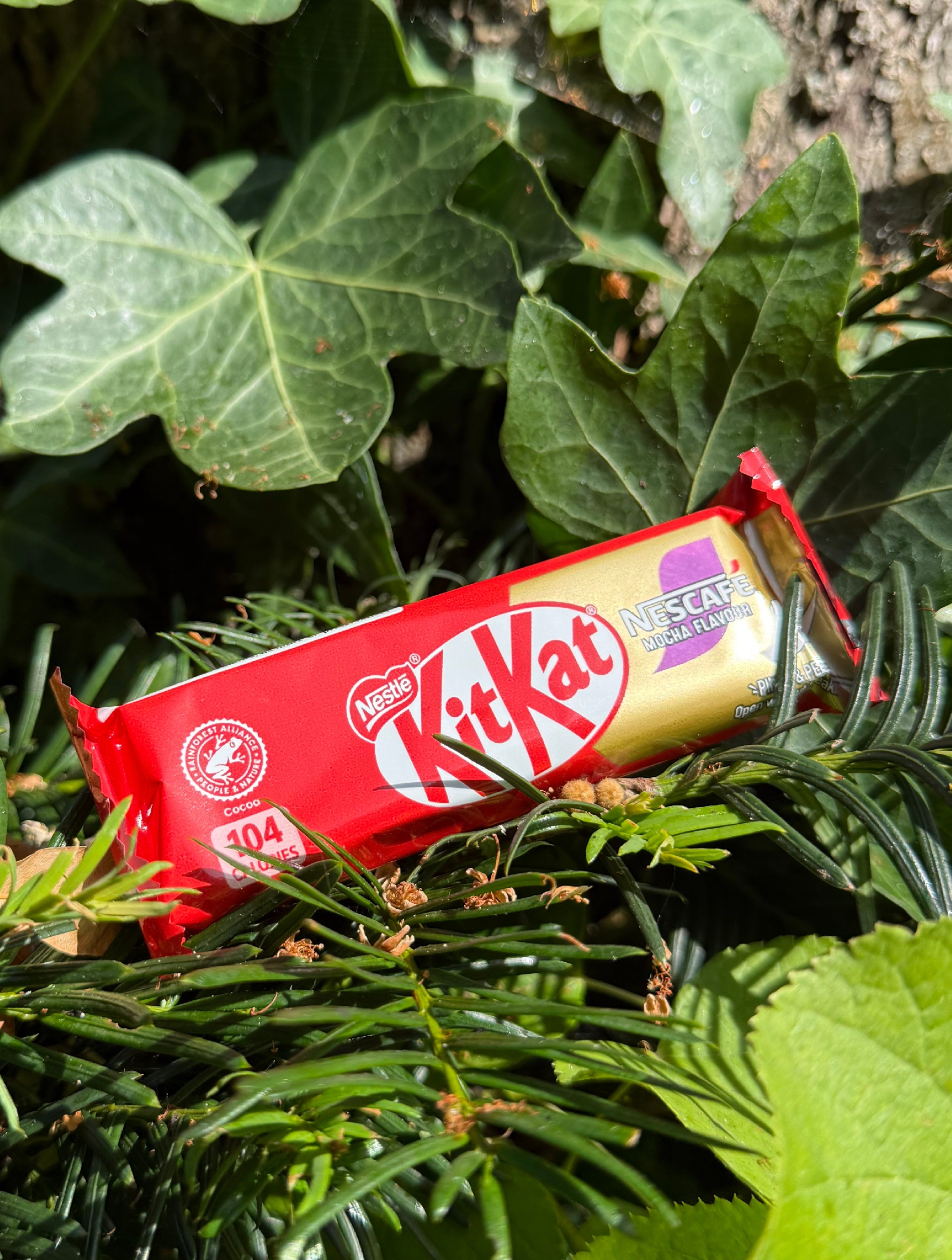
Is this a step forward?
That’s not an easy question to answer…for various reasons.
It may be good for Wildfarmed, especially in the short-medium term, as it provides sustainable finance via an assured large-scale pipeline and market. A contract this big can keep a pioneer company stay afloat and grow in a fragile operating environment.
But is its shining star at risk of disappearing behind a corporate smoke screen?
Is its history, integrity and the inspirational journey of its co-founder, being used, by association, to launder the reputation of a transnational that has not covered itself in glory on the other side of the food system?
Is Nestlé’s primary motivation, planetary or reputational? Is this just greenwashing/halo-polishing for them? A small-scale good that distracts from the large-scale bad? Will this regen-cred be used to leverage more political influence to block, delay or dilute future regulation aimed at improving the healthiness of their portfolio?
Does it matter? (as Ian Gould of Beyond Zero says ‘idealism does not drill the seed...a contract does.’)
Let’s first take a side-step and dig into the history of the world’s biggest food company.
Nestlé’s marketing activities around infant formula led the World Health Assembly to establish the International Code of Marketing of Breast-milk Substitutes in 1981. It still repeatedly breaches the Code, undermining global efforts to protect, promote, and support breastfeeding.
Nestlé’s activity in low- and middle-income countries is associated with 11 million excess infant deaths between 1960 and 2015.
Nestlé has been implicated in child labour and human-trafficking for decades. In 2021, former child slaves, trafficked into Côte d’Ivoire, filed a lawsuit against Nestlé USA who they accused of aiding and abetting the illegal enslavement of thousands of children on affiliated cocoa farms.
Nestlé was recently found to have added sugar to infant milk and cereal products sold in Asia. Similar products in the global north contained no added sugar. A year later, it was caught again doing the same in Africa.
Nestlé’s greenhouse gas emissions are triple those of its host country, Switzerland.
After a Greenpeace campaign in 2010, Nestlé promised to stop buying palm oil (a KitKat ingredient) from mills implicated in the displacement of Indigenous peoples, the decimation of forests and their biodiversity. Seven years later, half of its palm oil still came from these same plantations.
Nestlé is the biggest plastic polluter of all food companies (only Coca-Cola and PepsiCo generate more, as bottles).
In 2022, Nestlé spent around $18.5 billion on marketing – mostly unhealthy ultra-processed foods, mostly targeted to young children – more than five times the operating budget of the World Health Organization.
In 2024, nine out of ten shareholders at the Nestlé AGM voted to continue to prioritise unhealthy foods
Nestlé uses its huge economic and market power to leverage political clout. It infiltrates public policy advisory bodies and dietary guideline committees (often via associations and front groups) as well as funding numerous scientists – serious conflicts of interest which generate a significant pro-industry bias.
It funds astroturf groups to lobby the US Congress to override new state laws aimed at banning the unhealthiest ultraprocessed foods from school meals.
It’s recently made a strategic move to develop partnerships with the United Nations and with academia including Tufts University.

There are other stories, several of which appear in Food Fight.
In my talk at Groundswell, I described the corporate dark arts including the ‘deadly Ds’ (dispute, doubt, distort, distract, disguise and dodge) that structured the middle chapter in the book, the one I wrote first.
While these stories are well documented, they may not be so well known among actors on the land/agriculture side of the food system, I don’t know.
Where do we land?
How does the regen community balance purity of purpose and integrity with scale and survival in the real world?
If it’s a journey, how long will it take? How do we ensure we’re on the right path? What trade-offs and compromises will be needed along the way and how do we decide what to do?
Again, no easy answers but we shouldn’t lose sight of the questions.
The tension between standardisation and prescription on one side, and diversity and farmer empowerment on the other is navigable. As Food Foundation et al suggest – the use of the term ‘regenerative’ on labelling could only be permitted when linked to specific, concrete actions or outcomes (e.g. increased carbon sequestration) with clarity that these are the only aspects of ‘regenerativeness’ about which claims are being made.
The goal, they argue, should be a whole farm system that operates in a regenerative state, and it is the farm to which the term ‘regenerative’ should be applied, not individual products.
I agree and I also think we need to see regenerative agriculture in the context of whole-food-system transformation – which means we need to consider purpose, power and process in any decisions on trade-offs.
So, back to KitKat question…on which I had a few lively chats, during and after Groundswell.
Most regen advocates recognize the harms perpetrated by Big Food corporations – probably a lot more following Chris Van Tulleken’s talk to a packed-out Big Top! – and the fact that Nestlé is putting something good into a very popular but unhealthy sugary snack.
But many argue that it doesn’t have anything to do with regen farming. Regen is not the fix for our UPF-saturated diets.
I understand this view, but I don’t agree with it. Again, I think we need a whole-of-food-system approach. Big Food corporations hold immense power – power that comes in many forms and is used for different purposes at different points in the food system, as and when needed. Big Food certainly takes a whole-system approach.
It’s all connected. I don’t think we can/should trade-off planet against people.
This is not a vendetta against a single food company. If we saw a consistent, large-scale movement across any corporation’s portfolio to balance the fiduciary duty to make profit with a consistent reduction in the harms it generates, then trust could begin to be built. This is what ‘direction of travel’ means to me.
Finally, the fact, as pointed out to me, that no rules are being broken begs the question – isn’t it time they were changed?
Which brings me to a concluding point of agreement.
Most citizens and public food system actors agree on the need for governments to actually govern for people and planet. Move away from the ‘do-nothing’ default. Re-balance power and re-set parameters and guardrails so that profit is not generated at the expense of human and planetary health (via the most profitable products which happen right now to be ultra-processed). Industry can innovate and form partnerships within these new parameters.
See you at Groundswell ’27 !
Excellent article Stuart, thank you. I'm one of many who picked up & shared the Nestle story. I admire the principles behind regen ag, but if there aren't boundaries the vultures will circle. I am sometimes asked to recommend regenerative farms; it's a difficult question to answer. Consumers just about understand current food labels. I would pick up a bunch of organic carrots, but regen farmed...I'm not so sure, despite Wild Farmed & their marketing.
I was attending your talk at Oxford’s Makespace this Spring -thanks to Henry!
I am working on urban-rural interface, in terms of nutrient cycle, cost of living, and potential of economic engines to identify and improve balance in human systems.
Who is an expert and a facilitator?
Political economists? Artists and influencers?
(In a right place at a right time, correct?)