
Picking battles, climbing trees

On (not) saving the world, fighting back…and the joys of a bout of weekend genealogy…
First, how to do good without annoying everyone?
For over three decades, Anthea Lawson has fought on many campaigns – targeting the arms trade, corruption, tax secrecy – for groups including Global Witness and Amnesty International.
In her punchy new book, she describes the save-the-world script that too many of us have adopted, before exploring its alternatives – different ways to avoid the self-righteousness, purity traps and other habits that tend to wind people up.
How do we work together to make a difference, without alienating people, especially those who we need to convince?
Each chapter title is a declaration, a stake in the ground:
I am good, I protest, I know better than you, I save people, I’m a hero, I must save the world now.
And for each, she highlights the blind spots.
I’ve been interested in how activism in the food and health space has evolved over the years (in focus and tactics) as well as side questions like ‘can you be an academic and an activist?’
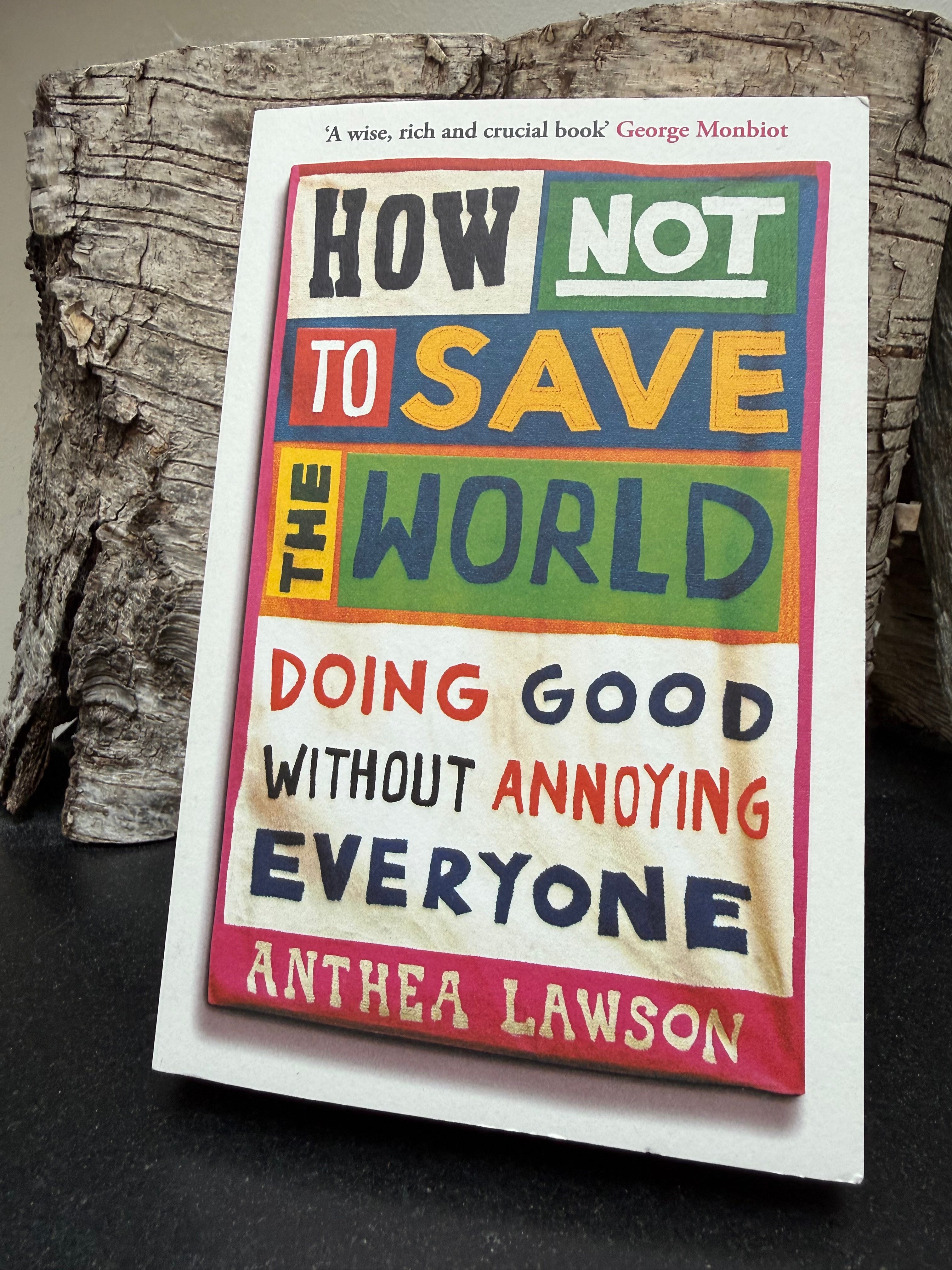
From this perspective, here’s a quick review interspersed with a few reflections…
In ‘I am Good’ Lawson reminds us that the bad guys are enabled, incentivised and emboldened by bad systems, and it’s the systems we need to dismantle.
Systems however are hard to grasp in the abstract — we all gravitate to stories, which, as any screenwriter knows, have protagonists and antagonists.
‘I Protest’ talks of the importance of protest but also the need to switch gears after the march, when we need to adopt other tactics and language. We may have an influence on others, but we can only ever be a catalyst for them to change their own minds.
And it ain’t easy…as Upton Sinclair pointed out in 1935:
‘It is difficult to get a man to understand something when his salary depends on his not understanding it’
When it comes to changing minds, Lawson suggests, the most profound effects relate to who we spend time with, and what we actually do.
In ‘I am Pure’, she highlights the purity traps that our egos suck us into – the notion that the moral high ground we think we inhabit demands absolute ideological alignment. All or nothing.
It’s a trap because it alienates people, it’s unrealistic and it can easily become an own goal – when failures in purity (e.g. buying a UPF snack) are used as a distraction from the real challenge which is to change the system that over-produces them.
We live in the real world in which we’re constantly making ethical compromises. It’s about balance.
Allied to this is the view that you’re not sufficiently ‘activist’ unless you’re doing direct action. Lawson shoots this down – rather, we should think of a movement as an ecosystem of people and forces in which there are many niches and opportunities to drive change.
‘I Save People’ tells the well-thumbed story of the white saviour – a ‘hero’ attached to a power imbalance.
Fortunately, it’s less obvious nowadays. When I started out in the early ‘80s it pervaded international development. As a 23-year old on my way to rural India, I was heavily influenced by it. Only when I got there, did I quickly see how ridiculous it was.
Lawson reminds us of Ivan Illich’s 1968 address to young Americans travelling to volunteer in Mexico, in which he suggests they’d be better off working among the poor in their own country ‘At least they can tell you to go to hell in a language you understand.’ Ouch…
I had a similar lecture in 1984 from Maoist revolutionaries in an Indian forest.
Decades later, Teju Cole described the white saviour industrial complex as not being about justice at all, but about having a big emotional experience that validates privilege.
The power imbalance that enables saviours is bedded into the global arena of aid and development (this segment of her book aligns with a chapter in Food Fight).
The core contradiction of philanthro-capitalism is the fact that endowments have been built by investing in corporations that make profits by extracting resources and wealth from the poorest countries. Debt repayments from global south to the global north exceed any aid going in the other direction.
Is this the circularity we’re looking for?
The development story and the saviour story reinforce each other. We need, of course, to fight for fairer political and economic systems, not just more aid. This also explains why some do not mourn the loss of development aid when it doesn’t address power, when it’s so tied to conditions that donors control (project not core funds, short-term KPIs, donor priorities etc).
‘I am a Hero’ describes someone who is trying a little too hard to be the centre of their own story….which is also a reflection of the hierarchies we’ve all grown up in.
‘The fallibility of a party leadership built around one person and their small team at the top is why an increasing number of people think that distributed decision-making and citizens assemblies must be the next democratic frontier.’
We need to ditch the ‘narcissism of small differences’ that splits us into ever-smaller groups. By fragmenting ourselves, we can’t grow power, we’re just playing into the hands of those who want to lock in business as usual.
The book concludes with a powerful call for a more collective approach, inspired by Ubuntu (‘I am because we are’) and the building of movements and coalitions that draw on different forms of knowledge and experience.
To fight…or not to fight?
In a recent Root and Reason webinar, lobbyist-turned-‘futurist’ Jack Bobo made a plea for ‘De-escalating the Food Fight.’
Unsurprisingly, I had a few thoughts on this, building from an earlier post:
How can we seriously talk about de-escalating any tension or conflict without fully surfacing the underlying causes?
How is it possible to build trust when there’s a basic disconnect in purpose that’s linked with a huge imbalance in power?
Who benefits from sugarcoating these realities?
We know the most powerful actors in the food system use their power in different ways:
Economically, to aggressively market ultra-processed/ultra-profitable products, which are the least healthy for people and planet.
Politically, to confront governments who try to regulate them in order to derail, delay and/or dilute policy that seeks to protect public health (via lobbying and increasingly, corporate litigation)
Without a proper recognition and discussion of purpose and power, any exhortation to trust each other is facile and doomed to fail.
‘Power concedes nothing without a demand. It never did, and it never will’
Frederick Douglass, 1849
I asked Bobo about purpose but his response was about approaches.
A food fight, moreover, can be against something or someone...or it can be FOR something. Most of us are fighting FOR a food system that puts people and planet first, a fight that only those in power want to de-escalate…for obvious reasons.
We need to keep digging deeper into the realities of our dysfunctional food system and laying the groundwork for one in which purpose and power are better aligned.
Like it or not, sometimes this involves a bit of a fight…call it a struggle, if you prefer!
Here’s Lawson’s take on fighting for change:
‘A typical criticism of campaigning that tries to be nice to people or to behave in a good way is that it’s the respectability politics of middle class liberals who’ve never had to fight for survival.’
Those who support business-as-usual or deregulation…
‘…are really arguing for the evisceration of our capacity to protect people, society and the natural world from the quest for profit.’
Lost English
Last week, I had an urge to do a spot of genealogy, as you do…I guess for two possible reasons.
The first was a discussion in various fora on the role of writing (by humans) in the age of AI.
Basically, what’s the point of it?
My view is that, yes, of course AI can help you with syntheses, summaries, reviews and descriptive cross-country comparisons. It can also mimic your writing style.
But what it can’t do is know what you’re thinking now, in this very moment. It cannot know you better than you do. For me, some of the most compelling writing emerges after the author has shifted gears, changed her/his mind, delved into new territory. How can any ‘in the style of X’ instruction beat that?
The genre least likely to be affected by AI is memoir.
Way back in the dark days of lockdown, I signed up to Ancestry, started a family tree before getting bored with it. I couldn’t figure how to use it and I couldn’t be bothered with any online tutorial. But last month, on my cycle ride through France, I met an old pal who told me he’d traced his lineage back to William the Conqueror.
What…how is that even possible?
So on my return to the laptop, I dived back in, and my tree is now growing (…not as far back as 1066, but I did recently reach the 17th century.)
The first thing that struck me after a few hours of intergenerational excavation is the simple fact that the English are a minority in our family tree.
Most of my wife’s and my ancestors were deracinated Celts – Scottish, Welsh and Irish tribal folk who were pushed out to the fringes by invading Angles, Saxons and Jutes from Germany and Denmark in the 5th century, after the Roman’s had left our shores.
My dad’s lot were all Scottish agricultural labourers, miners and carters – apart from the occasional fire-and-brimstone character, like John ‘Thundering Preacher’ Gillespie, who interspersed his religious life with…er…fathering ‘at least’ 21 children.
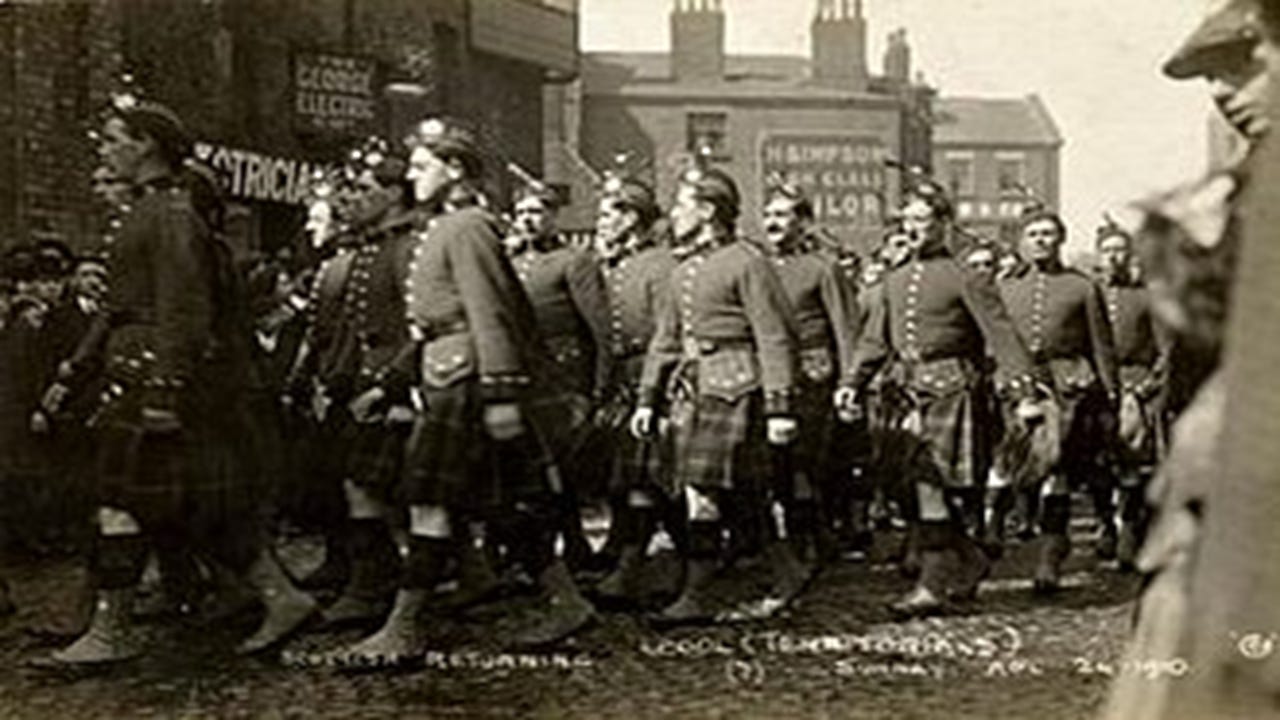
A handful of the Gillespie clan moved south after my grandfather returned from the First World War. He had served with the Liverpool Scottish (pictured), the first battalion to arrive at the Western Front in November 1914. He was 23 years old. Unlike most of his friends he survived.
After the war, another survivor offered him an apprenticeship in his father’s tailoring business, over the border. He left Scotland for good, moved south and fell in love with his employer’s daughter. They married, and my dad was the youngest of their two sons, born in 1931.
On the other side of the tree, my wife, Lindsay was born in Cardiff (as was our daughter, 35 years later). Nearly all her ancestors were from south Wales or southern Ireland (Cork).
A lot of Ancestry-trawling involves scrolling through handwritten censuses with mangled spelling. But then, suddenly, a character or story stops you in your tracks. Like Dr Diana Beck (my first cousin, twice removed, born in 1900) who was the world’s first female neurosurgeon. Not only did she smash the glass ceiling, she did so while suffering from a neurodegenerative disease herself, one that eventually killed her in her fifties.
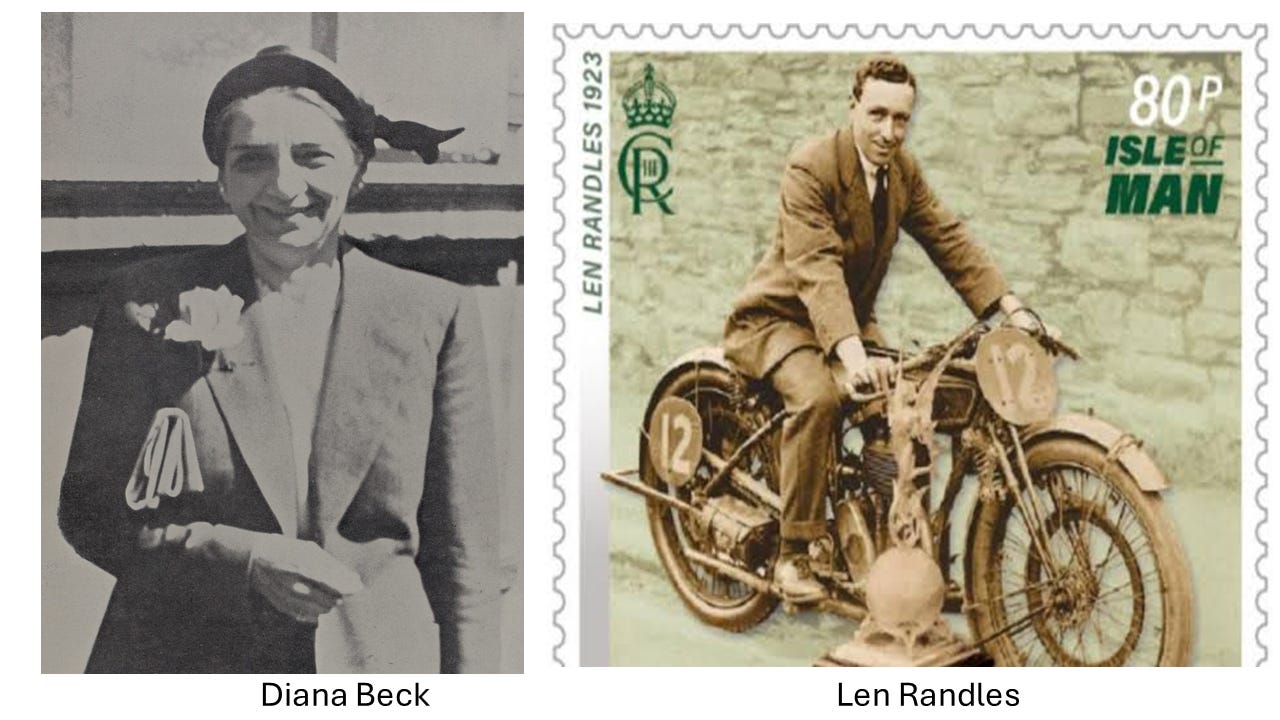
Then there was my great-uncle, Len Randles, another WW1 survivor. The laid-back guy that I remember had stormed his way to victory in the first two years of the amateur Isle of Man TT (1923-24) – one of the toughest motorbike races on the planet.
Which brings me to the second possible reason for digging into the past last week.
Could it have been a subliminal attempt to come to terms with yet another World Cup semi-final defeat by England?*
If I’m not really that English, why should I care? :)
(*mind you that crazy game against the French was a lot of fun! :)
Especially like your critique of Bobo’s approach.