
Dog day dispatches


I’m just back from cycling around in a French canicule…
A fascinating word that, as I’m sure you’re well aware, derives from the heliacal rising of the Dog Star (canicula in Latin).
According to Hellenistic astrology, this means heat, drought and fever.
The dog days of summer…
Fifty years ago, to the day, we had the start of ‘The Heatwave of the Century’ in the UK. Sixteen consecutive days with temperatures topping 32 degrees, 45 days without rain.
I remember it well…the weird combination of tropicana joy interspersed with torpor and fear: ‘it’s great but it ain’t normal…what’s happening?’
Reservoirs ran dry, eggs were fried on pavements in front of local news cameras, motorways buckled with the heat, umpires fell asleep at Wimbledon, sweaty buttocks stuck to plastic seats in millions of cars heading to the coast every Friday, communal standpipes were set up, hosepipes banned, and overnight the Minister for Sport became the Minister for Drought.
For some reason, tap water was not recommended to prevent dehydration. Sales of this new ice-cold beer-like liquid called ‘lager’ went through the roof, as did day-glo sugary drinks like Cresta, Corona and Tango.
The temperature peaked at 35 degrees – a peak that will be exceeded in London on three consecutive days this week. And this is before we see the global effects of a super El Niño that may be the most severe yet.
Doughnuts in France
As I was heading down to Grenoble for my alpine jaunt, I tuned into various podcasts including Amol Rajan’s Radical.
This episode with economist Kate Raworth was particularly good. It was really a conversation about what we value in life, why it’s crucial to differentiate ends and means, and what we’re going to do – as individuals, communities and societies – given we have but a nanosecond on this fragile planet. Nothing more, nothing less!
Raworth is the architect of Doughnut Economics that is a fascinating device for discussing what’s important for people and planet. It’s not my favourite metaphor (for obvious reasons) but I do admire the intent to chip away at a stitched-up neoclassical paradigm.
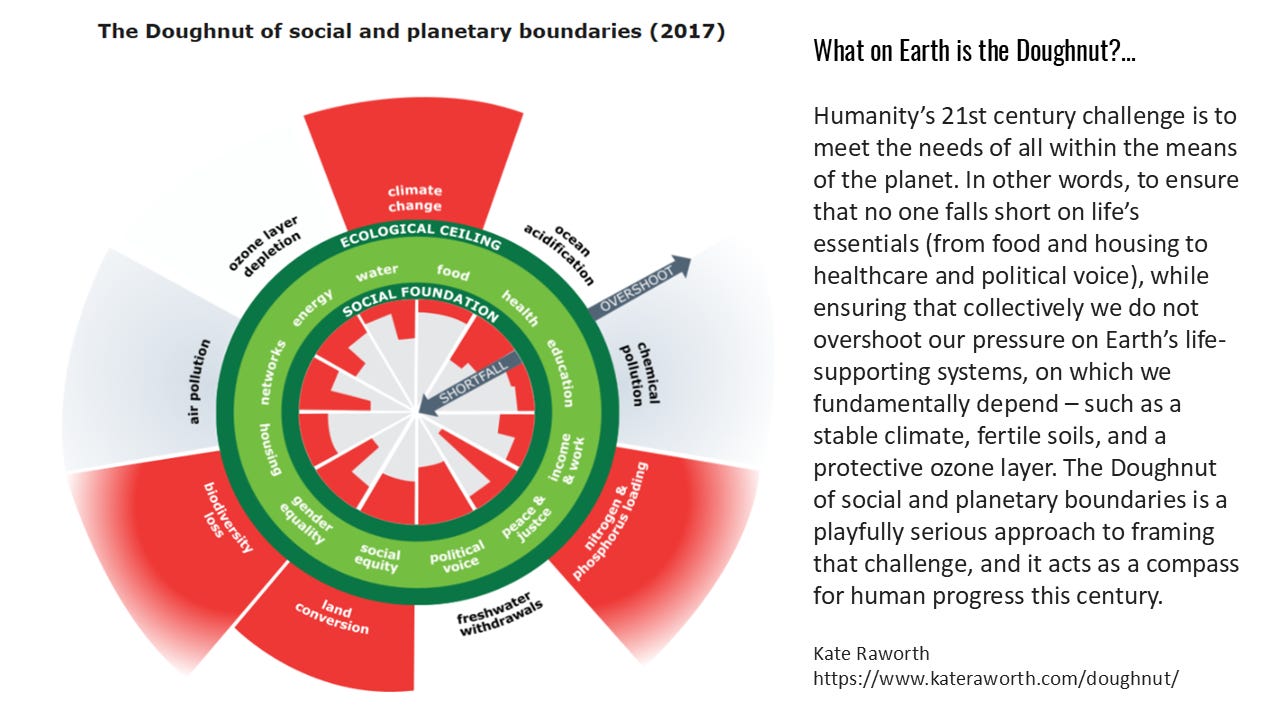
The inner ring of the doughnut represents the minimum basic needs for a healthy life (food, water, health, energy, housing, income, education, equity, voting power, peace, justice, etc.), while the outer ring represents an ecological ceiling or planetary limits within which we must all live if we are to survive into the next century.
We need to find a way of living that keeps us between the two rings – in the doughnut, as it were. Which means regenerative circular economies, that are much more localised, that deliver social and economic equity, and that are ecologically sustainable and resilient.
Nearly ten years old now, it’s been hugely influential.
Like many UK citizens, I’ve been hugely frustrated with our government’s unremitting obeisance to economic growth – as if that’s the ultimate goal. (will this change with a new prime minister?)
What’s the point of growth? Isn’t that the question?
As Raworth says, growth is a phase in life. Nothing grows forever. If something keeps growing in a mature body, it usually isn’t healthy – sometimes it can kill you.
The ultimate goal of most organisms is to thrive, not to grow. A tree grows to a height determined by its ability to channel nutrients from its roots to its highest leaves. Then it stops and spends its time maturing.
We cannot expand the world. So, why is endless growth pursued and revered?
Raworth uses the analogy of the temperature of the human body – if our core is too low, we become hypothermic, if too high, we have a fever. Neither are good. A healthy temperature stays within boundaries when we’re in equilibrium.
I later discovered, thanks to Ben Wood (Grenoble resident and uber-prolific researcher on corporate power in ultra-processed food systems) that the city is an exemplar in the doughnut world.

Raworth co-authored this 10 June Guardian op-ed that argues growth is a doomed strategy.
‘Poverty is manufactured. That is the bad news – and the good news. What has been manufactured can be dismantled and replaced.’
There is a better way – a Roadmap for Eradicating Poverty Beyond Growth, which was recently launched in Geneva, under the auspices of the Global Coalition for Social Justice. If you agree with what is says, put your name to it…
This, in turn, followed the 4 June release of the Global Justice Report that attempts to set out a new vision for global progress that grounds human development and equality in planetary habitability.
UP-date
Another month, another slew of papers and feisty social media tussles on ultra-processed foods.
Here are five that rose to the surface, for me:
First, the American Journal of Public Health released a series of papers on Ultraprocessed Foods and Corporate Influence – 18 in total (10 research, 6 editorial and 2 commentaries) by a stellar group of researchers.
The release is linked to the launch of Fed UP! – a science-first movement of researchers, scientists and organizations working to educate the public about ultra-processed food and advocate for healthier food systems grounded in evidence, transparency, and accountability.
I have avoided getting too pulled into the latest developments in MAHA-world, as there are much more adept on-site scribes like Marion Nestle and Helena Bottemiller Evich taking on that herculean task. But I was interested to dig into Marion’s editorial on the 2025–2030 Dietary Guidelines for Americans. For the first time since they were established in 1980, these called for
‘a dramatic reduction in highly processed foods laden with refined carbohydrates, added sugars, excess sodium, unhealthy fats, and chemical additives.’
But…and here’s the rub…the prescription is on you to take personal responsibility for what you eat. There’s a glaring absence of any mention of health equity, social or commercial determinants of health.
The policy focus is on education – not industry regulation. MAHA defers to MAGA.
Compare with the 2015 guidelines in Brazil that included advice to ‘Make natural or minimally processed foods the basis of your diet,’ while making it clear that healthy diets required socially and environmentally sustainable food systems.
The US guidelines, as Nestle says, sharply diverge from consensus in recommending a doubling of protein (…basically, meat). Hardly surprising when we learn that four of the nine writers of commissioned research reviews reported financial ties to meat and dairy industry groups, and three more disclosed ties to other food industries. Here we go again….
Next up is Samuel Dicken’s review on the purpose of food processing and ultra-processed food which makes some really useful contributions. Foremost among which is the need to keep asking questions about purpose. The purpose of ultra-processed foods is to maximise profit. UPFs are ultra-profitable, and...
‘There are currently no incentives for the commercial food industry to provide affordable healthy food. Commercial success can be achieved within a healthy and sustainable food system, but fundamental changes are needed to move from unrestricted economic growth as the sole driver of the food system, to economic growth, health and the environment.’
Third, a commentary by Angie Carriedo and colleagues that builds on the 2025 Lancet Series to identify pathways for effective policy and civil society action – focusing on the political economy of UPF proliferation and the role of local and community-based food systems in countering corporate power. Along with national regulatory and legislative policy action, the authors recommend strengthening food sovereignty through community financing and support for small-scale producers.
And then there’s this perspectives piece by Jimmy Chun Yu Louie. Two statements caught my eye:
‘The ultraprocessed food debate has become increasingly polarized, with methodological critique often dismissed through rhetorical rather than scientific means.’
‘Distinguishing legitimate scientific concerns from industry-influenced opposition requires evaluating methodology independently of funding sources.’
This one deserves a response.
The notion that methodological critique of UPF research is ‘a rhetorical approach that risks conflating legitimate scientific discourse with corporate interference strategies’ is flat-out untrue.
The accusation that anyone who oppose conflicts of interest is employing a non-scientific, rhetorical approach is, I think, insulting.
There are numerous scientific papers in reputable journals – many highlighted in past newsletters, summarised here – that show that conflicts of interest confer systematic and significant bias. Bias that may be driven by several, overlapping routes relating to the way research questions are framed, methods chosen, analyses done, interpreted, reported and/or published.
The fact remains that in the aggregate, there is bias. This is evidential, not rhetorical.
Later in the paper, the author – who is co-editor of BMJ Nutrition – suggests that industry-funded study ‘contributions merit engagement with their substance rather than dismissal based on provenance.’
I beg to differ (…that’s the polite response)
This is like suggesting disclosure of conflict nullifies it. It doesn’t – the conflict remains, as does its implications.
Just imagine how this could play out if we take a laissez-faire/anything goes approach. Here’s a study on sugar-sweetened beverages….let’s just ignore the fact it’s funded by Coca-Cola and judge it like any other study. Coca-Cola, PepsiCo et al would flood the zone…it’s nonsense. The aggregate bias means conflicts matter which means they cannot be brushed aside.
Finally, to end on a positive…following the successful reduction of ultra-processed foods in schools, Brazilian scientists and politicians are turning their attention to improving patient health with locally grown and freshly prepared meals.
Corporate affairs
A powerful joint investigation by Cuestión Pública & Lighthouse Reports (captured in this Thin Ink post) exposes how Colombia’s UPF industry blocked public health regulation, filing numerous lawsuits to overturn healthy taxes and front-of-pack labeling aimed at curbing rising childhood obesity. Fifteen bills in the last decade have been stymied by industry-funded groups. Lobbying is rife – between August 8 and November 16, 2022, there were at least 261 visits to Congress by food industry associations and companies.
*
On lobbying, this from a punchy blog by Sue Pritchard, FFCC:
‘So the question I want to answer — what share of these firms’ income comes from food and farming — has no answer in the public record. Not because nobody has tried counting. Because the system is built so the sum cannot be found.’
Indeed….this echoes what we found in work with the Food Foundation.
*
Meanwhile, the CEO of Mondelēz is not happy….all this talk about regulating HFSS products has given him a headache. He feels ‘we should work a lot harder on our kids, and how we educate them about nutrition.’ No comment needed here.
*
From Bath University, the Local Health Global Profits (LHGP) programme has released this useful brief that highlights key Do’s and Don’ts when discussing commercial determinants of health (CDoH) with policymakers and the public.
*
More bluewashing
Hot on the heels of the UNU – Nestle alliance, we have another UN body (the United Nations Capital Development Fund, UNCDF) jumping into bed – in this case, with the Bayer Foundation to launch a Food Systems Innovation Finance Facility. Once again, an open letter calls for an independent conflict-of-interest and corporate accountability assessment, stronger UN safeguards governing engagement with corporate actors, greater transparency and accountability and food systems financing grounded in human rights, democratic governance, and the public interest
Odds and pods
In addition to Amol Rajan’s Radical, here are four more interesting podcasts:
Edible Empire by Neal Haddaway on the hidden costs of our food system.
Between the Lines – on the IDS/WFP report: Social Protection for Food Security and Nutrition: a Business Case.
Ed Davey’s new pod Reasons for Hope
Dan Banik’s on hope
UK update
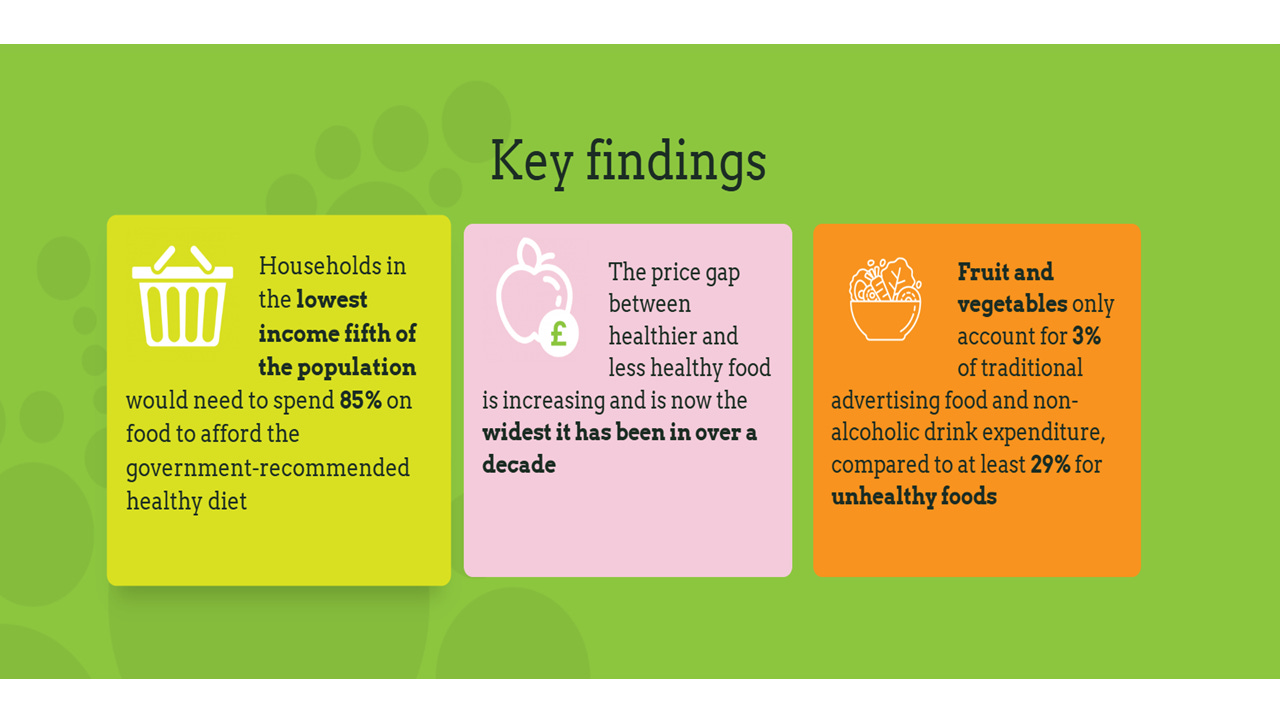
The Food Foundation’s Broken Plate 2026 is out, with these headlines:
‘Please confirm you are a human…’
{start rant}
Why, oh why, do ‘writers’ choose to go on this platform and paste in Claude’s musings?
I’m not against AI but why bypass your own brilliant mind with all its wonderful idiosyncrasies?
The ‘tells’ are so obvious and tedious. It doesn’t look good, and that’s even before we get to those godawful AI montages…
{end rant}
Thanks…
To the Guild of Food Writers for the Investigative Writer Award and the fab evening at the Royal Institute earlier this month.

I’m off to Groundswell in a week or so, where I’ll be in conversation with Chris Ramsay on 2 July at 10.00.
If you’re around, drop in!
Great post. This point is almost comical: “The ultraprocessed food debate has become increasingly polarized, with methodological critique often dismissed through rhetorical rather than scientific means.” I think many of the anti-UPF people are guilty of this, using tactics like zooming in on a singular edge case to “disprove” the entire concept, or acting like the incorporation of commercial determinants is somehow non-scientific.